PolySDL-STRUCTURAL DESIGN LAB
at Florida Polytechnic University
Active learning in Civil Engineering through structural design, modeling, testing, and experimentation
Cantilever bridge in action
A participatory investigation of force balance, tension, compression, and structural stability

Overview
This activity introduces cantilever bridge behavior through a physical recreation of the historic human cantilever demonstration associated with the Forth Bridge.
Student volunteers become part of the structural system, allowing the class to see - and physically experience - how a suspended central load is transferred through cantilever arms to the supports and anchors. The activity combines prediction, physical participation, free-body diagrams, and guided discussion to connect structural theory with an intuitive understanding of load paths and equilibrium.
Why This Activity Matters
Cantilever bridges can appear structurally complicated, particularly when viewed only through photographs or analytical diagrams. This activity reduces the system to its essential components and makes the internal force behavior visible.
Students observe that structural stability depends on the balance of the entire system. A change in the suspended load affects the forces carried by the cantilever arms, supports, and anchors. By participating in the model, students gain a memorable understanding of how tension and compression work together to maintain equilibrium.
Connection to Structural Engineering
The activity connects concepts from:
-
Statics
-
Strength of Materials
-
Structural Analysis
-
Bridge Engineering
-
Structural Form and Behavior
Students apply ideas related to:
-
free-body diagrams
-
equilibrium
-
load paths
-
support and anchor forces
-
tension and compression
-
structural stability
-
symmetry
-
the relationship between structural form and force flow
Activity Status
In Development
Main focus
Cantilever action, Force Balance, Tension and Compression, Stability
Course Connection
Statics, Strength of Materials, Structural Analysis
Tools / Platforms
Human Cantilever Model, Free-Body Diagrams, Guided Discussion, Physical Observation
Activity Type
Participatory Demonstration / Kinesthetic Investigation
Team Format
Whole-Class Activity with Student Volunteers
Mode
Physical
Key Deliverables
Force Prediction, Free-Body Diagram, Tension–Compression Identification, Observation Notes, Reflection
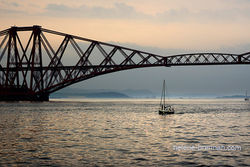
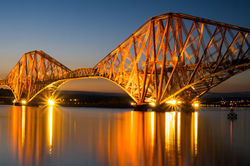
The Forth Bridge, a landmark cantilever railway bridge spanning the Firth of Forth in Scotland. Opened in 1890, it is now a UNESCO World Heritage Site.

Technical Snapshot
-
Structural concept: Balanced cantilever system supporting a suspended central span
-
Model basis: Benjamin Baker’s human cantilever demonstration
-
Primary load: Suspended central weight, W
-
Symmetric response: Each side of the system supports one-half of the central suspended load
-
Upper cantilever elements: Primarily in tension
-
Lower cantilever elements: Primarily in compression
-
Primary concepts: Equilibrium, force balance, anchorage, tension, compression, and stability
-
Response studied: How changing the central load changes forces throughout the system
Historical Context
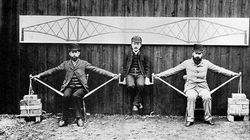
The activity is inspired by bridge engineer Benjamin Baker’s human demonstration of the cantilever principle, developed to explain the structural behavior of the Forth Bridge.
In the historic demonstration, three people, chairs, anchoring weights, and connecting members represented the principal components of the bridge. The person suspended in the center represented the central span, while the participants on either side transferred the load through the cantilever system to the anchors.
The Forth Bridge, completed in 1890 across the Firth of Forth in Scotland, was a bold large-scale application of the cantilever principle and was the world’s longest-spanning cantilever bridge at the time of its construction.

Kaichi Watanabe, seated at the center, participates in Benjamin Baker’s demonstration of the cantilever principle. Public-domain image.
The Cantilever Challenge
Before assembling the physical model, students examine the structural arrangement and predict how the central suspended load will be transferred through the system.
Students are asked to:
-
draw a simplified free-body diagram,
-
predict the force resisted by each side under symmetric loading,
-
identify which components will be in tension,
-
identify which components will be in compression,
-
explain the function of the anchors, and
-
predict how the structural forces will change if the central load increases or is removed.
Student volunteers then form the physical cantilever system under instructor supervision. The class observes how the load is transferred and discusses what the participants can physically feel in the members and anchoring connections.
After the demonstration, students revisit their initial predictions and explain:
-
how the suspended central load is shared,
-
why the upper and lower members experience different force types,
-
how the anchor system maintains equilibrium,
-
what would happen if one side were weakened or released, and
-
how the physical model represents the structural behavior of the Forth Bridge.
The activity emphasizes that the stability of a cantilever bridge depends not on a single member, but on the balanced interaction of the suspended span, cantilever arms, supports, and anchors.
Full details regarding model construction, safety, instructional sequence, free-body diagrams, discussion questions, and student deliverables are provided in the PolySDL Activities Handbook.
This PolySDL activity is adapted from the Human Cantilever Model of the Forth Bridge developed through Princeton University’s Creative Art of Structural and Civil Engineering teaching resources. The content presented here has been reorganized and rewritten for use within PolySDL.
Related Photos and Project Examples
 |  |  |
|---|---|---|
 |
Selected images from related fabrication, testing, or previous project examples.