PolySDL-STRUCTURAL DESIGN LAB
at Florida Polytechnic University
Active learning in Civil Engineering through structural design, modeling, testing, and experimentation
Balsa Bridge Competition
A hybrid design-model-build-test competition in truss analysis, structural efficiency, and experimental validation

Overview
This activity challenges student teams to design, analyze, fabricate, and test a balsa-wood truss bridge. Each bridge must span 24 inches and have a width of 6 inches. Teams prepare full-scale AutoCAD construction templates, develop a structural model in SAP2000, predict the bridge’s failure load, and fabricate the physical model in the Structures Laboratory.
On competition day, each bridge is weighed and loaded to collapse. The measured load-carrying capacity is compared with the analytical prediction, allowing students to evaluate both the structural efficiency of their design and the accuracy of their computational model.
Why This Activity Matters
Successful structural design is not simply about producing the strongest possible structure. Engineers must balance strength, stability, stiffness, material use, constructability, workmanship, and cost.
The Balsa Bridge Competition brings these considerations together in one integrated project. Students see how truss geometry, member forces, compression buckling, connection quality, and fabrication accuracy affect actual structural performance. The activity also demonstrates that even a sound analytical design may behave differently when material variability and construction imperfections are introduced.
Connection to Structural Engineering
This activity connects structural-analysis theory with the design and behavior of a physical truss system. Students apply concepts including:
-
structural idealization and load paths
-
support conditions and applied loading
-
axial forces in truss members
-
tension and compression behavior
-
Euler buckling of compression members
-
material stiffness and strength
-
structural efficiency
-
analytical prediction and experimental validation
The project also introduces students to the relationship between a computational model and the physical structure it represents.
Activity Status
First Implemented, Spring 2026
Main focus
Truss Behavior, Axial Forces, Buckling, Structural Efficiency, Prediction vs. Test
Course Connection
Structural Dynamics, Structural Analysis
Tools / Platforms
AutoCAD, SAP2000, Excel, Balsa-Wood Fabrication, Physical Load Testing
Activity Type
Design-Model-Build-Test Competition
Team Format
Small Teams — typically 3 students
Mode
Hybrid
Key Deliverables
AutoCAD Drawings, SAP2000 Model, Capacity Prediction, Fabricated Bridge, Presentation, Test Comparison and Reflection

Technical Snapshot
-
Bridge type: Balsa-wood truss bridge
-
Required span: 24 in
-
Required width: 6 in
-
Construction drawings: 1:1 scale AutoCAD templates based on member centerlines
-
Structural analysis: SAP2000 truss model
-
Reference loading: 100 lb total load represented by four 25 lb joint loads
-
Capacity prediction: First predicted member failure through tension rupture or compression buckling
-
Material calibration: Effective balsa modulus determined through small-scale bending tests
-
Measured responses: Load-carrying capacity at collapse and bridge self-weight
-
Efficiency measure: Load-carrying capacity divided by self-weight, LCC/SW
The Design Challenge
Student teams must develop a truss bridge that satisfies the required geometry while achieving high structural efficiency and reliable performance.
Each team selects its truss form, member arrangement, member dimensions, bracing configuration, and joint details. The proposed bridge is first documented through full-scale AutoCAD drawings showing the side, plan, and front views. These drawings become the templates used during fabrication.
Teams then create a corresponding SAP2000 model using the physical support and loading conditions. Member axial forces are obtained from a reference-load analysis, and the predicted failure load is calculated by comparing member demand with tension and compression capacities. Students must identify the governing member and state whether the predicted failure is caused by tension rupture or compression buckling.
After completing the analysis and prediction, teams fabricate their bridges from balsa wood, verify dimensional compliance, measure self-weight, present their design, and load the bridge until collapse. The final evaluation compares the predicted and measured capacities, observed failure location, fabrication quality, and overall structural efficiency.
The goal is not merely to build the bridge that carries the greatest load. Teams must create a design that is efficient, accurately modeled, carefully fabricated, and supported by sound engineering judgment.
Full details regarding geometry limits, loading points, AutoCAD templates, SAP2000 modeling, material calibration, capacity calculations, fabrication requirements, scoring, testing, and final deliverables are provided in the PolySDL Activities Handbook.
Related Photos and Project Examples
 |  |  |
|---|---|---|
 |  |  |
 |  |  |
 |
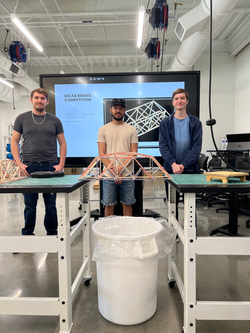
Selected images from related fabrication, testing, or previous project examples.
Bridge testing